Let’s Address the Elephant in the Room
If you’ve spent any time online lately, you’ve probably seen the headlines.
“Ozempic face.”
“Ozempic butt.”
“GLP-1 drugs destroy muscle.”
“They cause cancer.”
“They’ll make you go blind.”
“They don’t work.”
“They work too well.”
Depending on who you ask, GLP-1 therapies are either a miracle breakthrough or a public health disaster waiting to happen. Neither view reflects what the science actually shows.
The reality is far less dramatic—and far more interesting.
What’s particularly surprising isn’t the criticism. Every major medical advancement attracts skeptics. The more remarkable phenomenon is how often the conversation becomes oversimplified.
Critics frequently portray GLP-1 therapies as dangerous shortcuts, while supporters often portray them as complete solutions. Both perspectives miss something important.
The emerging science suggests that GLP-1-based therapies—and newer investigational compounds such as Retatrutide—may represent one of the most significant developments in metabolic research in decades.
But they’re not magic. They don’t eliminate the importance of nutrition. They don’t replace physical activity. They don’t solve every aspect of metabolic health. And they certainly don’t justify many of the exaggerated claims circulating online.
So what does the evidence actually tell us?
Let’s separate the myths from the facts.
Myth #1: Retatrutide Is Just Another GLP-1
Fact
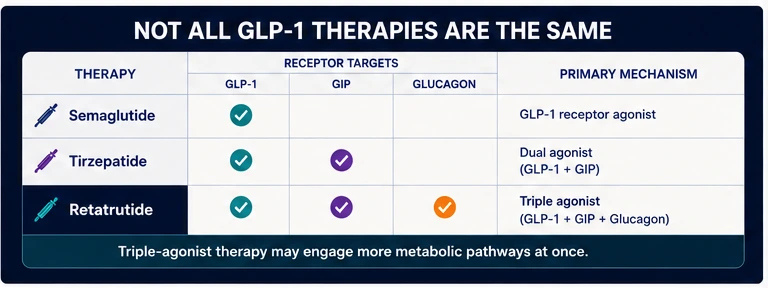
Retatrutide is not simply a newer version of semaglutide.
Researchers classify Retatrutide as a triple-receptor agonist because it targets:
- GLP-1 receptors
- GIP receptors
- Glucagon receptors
This combination is designed to influence multiple metabolic pathways simultaneously.
While semaglutide focuses primarily on GLP-1 signaling and tirzepatide targets both GLP-1 and GIP pathways, Retatrutide introduces a third mechanism through glucagon receptor activation.
Researchers believe this additional pathway may contribute to increased energy expenditure and metabolic adaptation, helping explain why Retatrutide has generated so much interest in metabolic research.
In short, this is not simply a stronger GLP-1. It represents an entirely different generation of metabolic science.
Myth #2: GLP-1 Therapies Work By “Starving” People
Fact
One of the most common misconceptions is that GLP-1 therapies work by forcing people to stop eating. The reality is much more nuanced.
GLP-1 is a naturally occurring hormone involved in:
- Satiety signaling
- Insulin regulation
- Gastric emptying
- Glucose metabolism
These therapies appear to help regulate biological pathways that influence hunger, food intake, and metabolic signaling. That distinction matters.
The goal is not starvation. The goal is improved metabolic regulation.
For many researchers, one of the most important lessons from GLP-1 science is that obesity is not simply a failure of willpower. It is deeply connected to biological signaling systems that influence appetite, energy balance, and food-seeking behavior.
Myth #3: GLP-1 Therapies Were Created for Weight Loss
Fact
Ironically, one of the most common misconceptions about GLP-1 therapies is that weight loss was their original purpose. It wasn’t.
GLP-1 therapies were initially developed to help improve blood sugar control in individuals with Type 2 diabetes.
Long before these therapies became household names, endocrinologists were studying them because of their effects on glucose regulation, insulin signaling, and metabolic health.
This remains one of the most important aspects of the entire GLP-1 story.
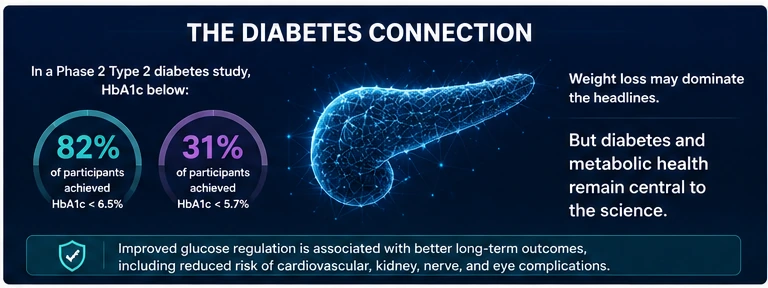
Clinical research involving Retatrutide has demonstrated substantial improvements in HbA1c, one of the most important markers of long-term blood sugar control.
In a Phase 2 Type 2 diabetes study, HbA1c below 6.5% was achieved in up to 82% of participants, while HbA1c below 5.7% was achieved in up to 31%.
Those numbers attracted significant attention because blood sugar control is not merely about improving laboratory values. Poor glucose regulation is associated with:
- Cardiovascular disease
- Kidney disease
- Nerve damage
- Vision complications
- Broader metabolic dysfunction
For many patients, improved glycemic control may be every bit as important as changes in body weight.
Weight loss may dominate the headlines. But diabetes and metabolic health remain central to the science.
Myth #4: GLP-1 Therapies Are Only About Weight Loss
Fact
This may be the biggest misconception of all. Much of the public conversation surrounding GLP-1 therapies begins and ends with body weight.
But many researchers believe that perspective is far too narrow.
In many ways, both critics and supporters make the same mistake. They focus almost exclusively on weight loss.
Critics point to weight loss and warn about risks. Supporters point to weight loss and celebrate results. Yet both groups often overlook the same reality: researchers are increasingly interested in these therapies because of their effects on metabolism itself.
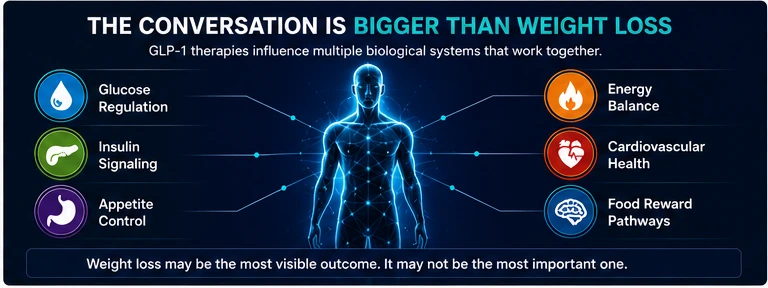
Weight loss may be the most visible outcome. It may not be the most important one.
Researchers continue investigating how GLP-1 signaling influences:
- Glucose regulation
- Insulin sensitivity
- Appetite signaling
- Energy balance
- Digestive physiology
- Food-reward pathways
- Cardiometabolic health
Obesity is not merely a weight problem. Type 2 diabetes is not merely a blood sugar problem. Both represent complex metabolic conditions involving multiple interconnected biological systems.
Reducing GLP-1 therapies to “weight-loss drugs” may ultimately be like describing a smartphone as merely a telephone.
Technically true. But far from the whole story.
Myth #5: The Weight-Loss Results Are Being Exaggerated
Fact
If anything, many people underestimate how significant the clinical findings have been.
Retatrutide has produced some of the largest weight-loss outcomes ever reported in obesity-drug research.
In advanced clinical trials, participants achieved average weight reductions approaching levels historically associated with bariatric surgery.
In Phase 2 obesity research published in The New England Journal of Medicine, higher-dose Retatrutide groups achieved average body-weight reductions approaching 24.2% at 48 weeks.
These findings are one reason the compound has generated extraordinary interest among researchers studying obesity, metabolic dysfunction, and cardiometabolic health.
At the same time, it’s important to recognize that long-term durability, maintenance strategies, and broader population outcomes continue to be studied. Science is still gathering data.
Myth #6: GLP-1s Cause Everyone to Lose Muscle
Fact
This is perhaps one of the most persistent misconceptions surrounding GLP-1 therapies.
Any significant weight-loss intervention typically results in some reduction of lean tissue. This occurs with:
- Dieting
- Exercise-based weight loss
- Bariatric surgery
- Pharmacologic interventions
The more important question is not whether lean mass decreases, but how much of the total weight loss comes from fat versus lean tissue.
Current Retatrutide body-composition analyses suggest that approximately:
- 75% to 80% of total weight lost consists of fat mass
- 20% to 25% consists of lean mass
At first glance, critics often point to that 20% to 25% figure and claim it proves substantial muscle loss. But that conclusion ignores two important realities.
First, lean mass is not synonymous with muscle.
Lean mass includes:
- Skeletal muscle
- Water
- Glycogen stores
- Connective tissue
- Organs and other non-fat tissues
A reduction in lean mass does not automatically translate into an equivalent reduction in functional muscle tissue.
Second, even if we assumed the entire 20% to 25% reduction represented muscle loss—which it does not—the percentage would still be generally consistent with what researchers have historically observed across many successful weight-loss interventions.
Whether weight loss occurs through calorie restriction, lifestyle modification, bariatric surgery, or pharmacologic therapy, some degree of lean-mass reduction is expected.
In other words, the body-composition changes observed with Retatrutide are not unusual simply because they occur during GLP-1 therapy. They are largely in line with what researchers have observed during successful weight loss in general.
The relevant question is not whether lean mass changes. The relevant question is whether the majority of weight loss comes from fat mass while preserving as much functional muscle as possible.
Current Retatrutide data suggest that the overwhelming majority of weight reduction achieved during treatment comes from fat mass.
Researchers continue studying how resistance training, adequate protein intake, physical activity, and other interventions can further optimize body-composition outcomes.
The current evidence does not support the simplistic claim that Retatrutide or other GLP-1-based therapies automatically “destroy muscle.”
Instead, the available data suggest that most weight lost during treatment comes from fat mass, while the proportion of lean-mass reduction remains generally consistent with what researchers have historically observed across many effective weight-loss approaches.

Myth #7: Researchers Are Hiding Serious Side Effects
Fact
If you’ve spent time on social media, you’ve probably encountered claims that GLP-1 therapies are causing everything from permanent digestive damage to blindness, cancer, organ failure, and countless other catastrophic outcomes.
These stories generate attention. They also frequently ignore how clinical research actually works.
Retatrutide and other GLP-1-based therapies have undergone extensive safety monitoring throughout development.
The most commonly reported side effects have generally been gastrointestinal in nature, including:
- Nausea
- Vomiting
- Diarrhea
- Constipation
- Gastrointestinal discomfort
Importantly, these effects are not hidden. They are openly reported in clinical data and discussed extensively by researchers.
That does not mean side effects do not exist. Every biologically active therapy carries both risks and benefits.
What we know today comes from clinical research. What we do not yet know with complete certainty are every possible long-term outcomes over decades of use. That is true of virtually every emerging therapy.
Current evidence does not support the claim that researchers are secretly hiding widespread catastrophic side effects from the public.
Many alarming stories circulating online are based on isolated anecdotes, misunderstandings of adverse-event reporting, or assumptions that correlation automatically proves causation.
As with all emerging therapies, long-term monitoring continues. But the claim that serious risks are being systematically hidden is not supported by available evidence.
Myth #8: GLP-1 Therapies Cause Heart Problems
Fact
One of the more surprising narratives circulating online is the claim that GLP-1 therapies damage the heart.
Current evidence suggests the opposite may be true.
Over the past decade, multiple large cardiovascular outcome studies evaluating GLP-1-based therapies have demonstrated reductions in major adverse cardiovascular events.
Researchers have observed reductions in outcomes such as:
- Heart attack
- Stroke
- Cardiovascular death
One of the most significant findings came from the SELECT trial, which reported a 20% reduction in major adverse cardiovascular events among adults with overweight or obesity and established cardiovascular disease.
These findings have become one of the most important developments in the entire GLP-1 field.
Because cardiovascular disease remains one of the leading causes of death among individuals with obesity, insulin resistance, and Type 2 diabetes, these outcomes matter.
Researchers believe improvements in blood sugar control, body weight, insulin sensitivity, and cardiometabolic stress may all contribute to these results.
This does not mean GLP-1 therapies eliminate cardiovascular risk. Nor does it mean every patient experiences identical outcomes.
But the claim that GLP-1 therapies are causing widespread heart problems is inconsistent with a growing body of cardiovascular research.

Myth #9: Retatrutide Is a Magic Bullet
Fact
Perhaps the biggest misconception is that any single therapy can solve every aspect of metabolic health.
Metabolism is extraordinarily complex. Body composition, energy regulation, sleep quality, physical activity, nutrition, stress management, hormonal status, and overall health behaviors all interact with one another.
Retatrutide may prove to be one of the most powerful metabolic tools ever developed.
But tools are not complete systems.
Even the most promising therapies operate within a broader physiological environment.
The most successful outcomes are likely to come from comprehensive approaches that include nutrition, movement, recovery, and long-term lifestyle habits.
No medication can fully replace those fundamentals.
The Bottom Line
The internet thrives on extremes. One side claims GLP-1 therapies are dangerous. The other side claims they’re miraculous.
The evidence suggests a more balanced conclusion.
Retatrutide appears to be one of the most promising metabolic research compounds currently under investigation. Its unique triple-agonist mechanism distinguishes it from earlier generations of GLP-1 therapies and may help explain the unprecedented outcomes observed in clinical trials.
At the same time, many of the loudest claims—both positive and negative—extend far beyond what the current evidence supports.
The science does not suggest that Retatrutide is a miracle. Nor does it suggest that it is the catastrophe some critics portray.
The biggest myth about Retatrutide may not be that it is dangerous. And it may not be that it is revolutionary. The biggest myth may be that its story can be reduced to body weight alone.
Because if the emerging science proves correct, Retatrutide may ultimately be remembered not as a weight-loss therapy, but as part of a broader shift in how we understand metabolic health itself.
What the evidence does suggest is that researchers may be witnessing the emergence of a fundamentally new approach to metabolic health—one that challenges many long-held assumptions about obesity, energy regulation, insulin resistance, Type 2 diabetes, and human physiology.
As always, the most reliable source of information remains the research itself, not the headlines.

Continue Exploring Advanced Research →
Retatrutide Research
GLP-1 Research
- What Is Semaglutide? Mechanism, Research Overview, and Scientific Context
- The GLP-1 Story — Explained Simply